

They’re amazing! So why doesn’t it work?
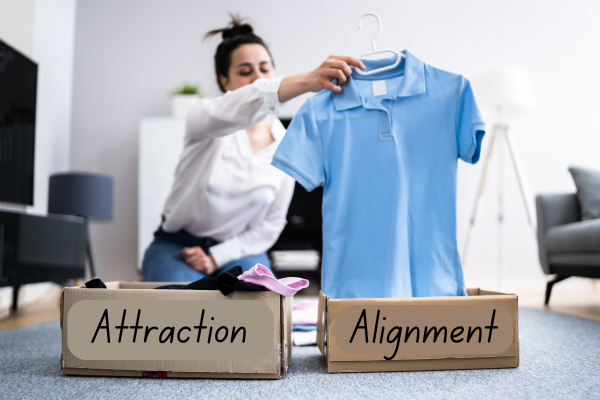
Attraction Is Easy. Alignment Is What Lasts: Creating Relationships Based on Values and Time
Attraction matters. Chemistry matters. Desire matters.
But attraction alone is not what creates a healthy, lasting, or deeply satisfying relationship.
Most people don’t struggle because they’re choosing people they’re not attracted to.
They struggle because they’re choosing people they are attracted to, and getting deeply involved quickly, without checking for alignment.
And those are two very different things.
Attraction vs. Alignment
Attraction is the spark.
Alignment is whether the fire can actually burn without destroying everything around it.
You can feel deeply drawn to someone and still be fundamentally misaligned in the areas that matter most:
Core values
Vision for life and partnership
Emotional availability
Conflict and repair style
Desire for intimacy, growth, or family
Attraction without alignment often leads to confusion, anxiety, and unnecessary pain, not because anyone is wrong, but because you’re trying to build something with mismatched blueprints.
Attraction isn’t something to suppress or distrust.
It’s information.
It’s just not the only information that matters.
Relationships Need a Purpose (Even If You’ve Never Named It)
Every relationship has a purpose, whether it’s conscious or not.
That doesn’t mean everyone needs to want marriage or children. But it does mean clarity matters.
For some people, the purpose of relationship includes procreation, parenting, and family, building.
For others, it may be companionship, emotional intimacy, shared growth, or creative partnership.
None of these are wrong.
What causes harm is when two people are operating from different purposes and hoping attraction will bridge the gap.
It won’t.
Clarity here isn’t about locking yourself into a rigid future, it’s about making sure you’re building in the same direction.
What You Must Give and Receive to Keep Giving
This is one of the most important, and most overlooked, parts of relationship discernment.
Understanding your needs is not about making a list of demands or handing someone a checklist.
Needs are not weaknesses.
Needs are the conditions that allow generous love to stay generous.
If you love deeply, give freely, and show up fully, you need to understand what allows that giving to continue without turning into depletion, resentment, or self-abandonment.
Needs are like languages.
We don’t all speak them the same way.
And here’s the part we often forget: no one is a mind reader.
Healthy relationships require us to slow down and ask ourselves what actually helps us feel connected, seen, and valued, and then learn how to communicate those needs without criticism or blame, in a way our partner would genuinely want to meet.
Most of us were never taught how to identify, name, and ask for what we want in a way that invites generosity rather than defensiveness. Isn’t it kind of wild that something so essential to intimacy is almost never taught?
Compatibility isn’t about having no needs.
It’s about choosing partners with whom your needs can be communicated, understood, and willingly met, and whose needs you are genuinely (mostly) happy to meet in return.
Many people find it helpful to slow this process down by writing their needs out—not to present them to someone else as requirements, but to bring clarity to themselves first.
When you know what you need, you stop asking for it by criticizing what your partner didn’t do when you’re already mad after the fact.
You stop hoping that if you just “meet the right person” your needs will always magically be met.
And you give your relationships a much better chance of thriving.
Values Mean Nothing Until They’re Lived
Many people say they value things like family, intimacy, honesty, growth, or connection.
But values don’t live in ideas.
They live in actions, rhythms, and choices.
A value that isn’t expressed in behavior is just a preference, or a wish.
For example, family is a common value, but it can mean very different things.
Family as a value in action might look like:
Eating dinner together three to four nights a week
Prioritizing holidays and shared traditions
Regular check-ins to cultivate connection outside of life’s to-do list
Protecting time together even during busy seasons
Or consider intimacy.
Intimacy as a value in action might look like:
Planned sex dates- not leaving erotic aliveness to chance or hoping you’ll get to it after too much netflix
Open conversations about needs, fears, and desires outside the bedroom in a relaxed, safe environment
Repair after rupture instead of avoidance- commitment to circling back instead of staying distant for a week after an argument
Two people can say they value the same thing, and still be deeply misaligned in how that value is lived.
Talk about how you want to live, early and often.
Don’t worry about being “too deep.”
Staying shallow is the greater threat to wasted time and misalignment.
If you’d like help translating your values into real-life actions, I created a simple worksheet you can download and work through at your own pace.
Enter your email below and I’ll send it straight to you.
Intimacy Takes Time (There Is No Shortcut)
No matter how amazing someone seems at first, you do not truly know them until:
You’ve had a disagreement
You’ve seen how they handle frustration
You’ve experienced how they repair after rupture
You’ve observed consistency over time
Real intimacy is revealed through patterns, not moments.
There is no substitute for time passing.
Not chemistry.
Not intensity.
Not potential.
This is also where many people feel confused.
You may wonder whether something is an old pattern getting activated, something to work through together, or a sign of deeper incompatibility. Having a grounded outside perspective can be incredibly helpful here, especially when emotions are involved, and clarity feels just out of reach. (If you’re going through this, it’s a great time for a coaching session where I can help you unpack it and get clarity.)
Final Thoughts
Healthy relationships aren’t built by hoping it will all work out.
They’re built by sorting clearly and early, based on the difference between attraction and alignment, shared purpose, honest awareness of needs and gifts, values lived in action, and allowing time to tell the whole story.
Most people you date will not be your person, and that’s not a failure.
That’s the process working.
The sooner you can sort based on what’s real instead of what’s hoped for, the less unnecessary confusion and wounding there is for everyone involved.
How bananas is it that we put more thought, planning, and intention into things like meal prep, workouts, or our work calendars than we do into what we’re actually creating in our intimate relationships?!
Yet who you choose as your partner is arguably one of the single most important decisions you will make, and your partner will influence your health, well-being, and overall success in countless ways.
So let’s create the best relationships we possibly can, with intention from the start.
To Your Best Connection, Monica
